Rope Weave, Wicker Or Aluminium: Choosing Outdoor Hotel Furniture For Heat, Salt And Sun
- Share
- publisher
- Karam Spaces
- Issue Time
- Nov 11,2026
Summary
For five-star hotels and luxury resorts, choosing between rope weave, synthetic wicker and aluminium is a specification decision, not a styling one. This guide from an experienced hotel furniture manufacturer maps salt, UV, housekeeping and seasonal storage conditions to a zone-by-zone outdoor hotel furniture schedule, with the test evidence and first-article checks procurement teams need before sign-off.
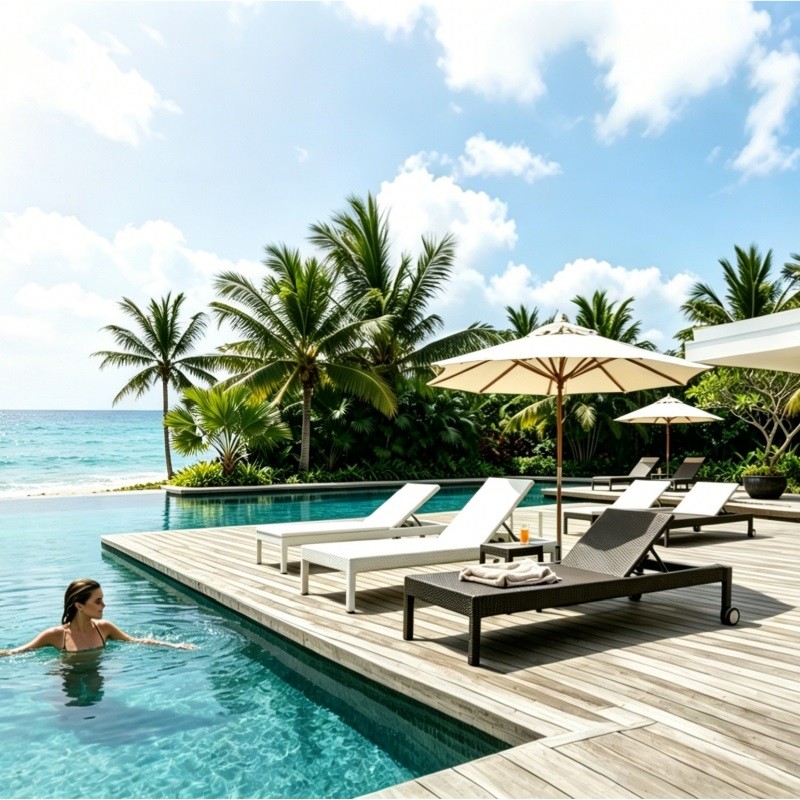
For a beachfront property, choosing between rope weave, synthetic wicker and aluminium is a specification decision, not a styling one. Three site conditions settle it: salt and UV exposure, how housekeeping cleans, and whether seating is stacked between seasons. As a Hotel Furniture Manufacturer, we have seen striking catalogue pieces fail in two seasons while plainer ones last a decade — almost never because of the look.
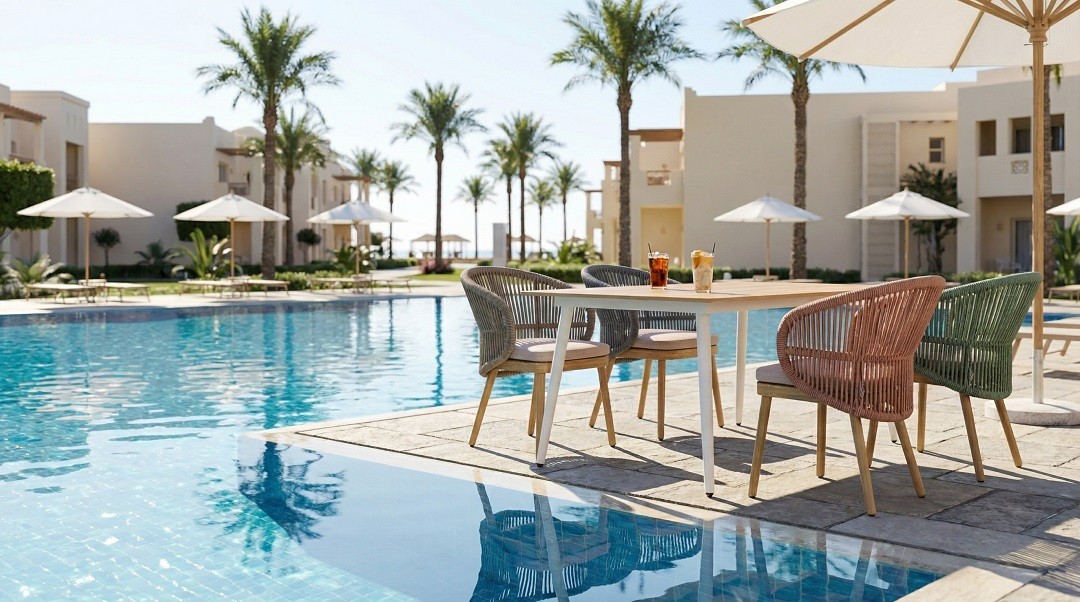
Why Luxury Hotels And Resorts Specify Outdoor Hotel Furniture By Climate
On a five-star property a pool deck is a revenue surface: cabanas are sold by the day, terrace tables turn three times an evening, and withdrawn seating costs the space and the review. Resort buyers therefore treat outdoor hotel furniture as an operating asset.
Brand standards want a Doha terrace and a Maldives terrace to read as the same hotel. Finance wants a replacement cycle in years, not seasons. Engineering wants documented load and corrosion data. Housekeeping wants pieces two people can reset before breakfast, and project teams need a finish and weave colour held across a phased opening. One discipline answers all of them: write a climate and maintenance brief before a mood board.
Three Site Conditions That Decide Rope Weave, Wicker Or Aluminium
The same chair behaves differently on a sheltered courtyard, an inland rooftop in 45°C heat and an exposed deck near the sea. The duty cycle changed, not the material.
Coastal Salt, UV Load And Wind-Borne Abrasion
Housekeeping, Chlorine And Daily Cleaning For Hotel Terraces
Ask housekeeping how they actually clean, not how a datasheet recommends. Hose-downs, chlorinated splash and pressure washing affect weaves, coatings and fixings differently: a weave that tolerates a gentle rinse can be opened by a pressure lance. Cleaning method is a material constraint, so it belongs in the brief. Shade does too — outdoor umbrellas and pergolas lower UV load and surface temperature, which is why a rope scheme that fails on an open deck can work beneath a cabana.
Seasonal Storage And Stackability For Resort Outdoor Furniture
Seasonal resorts stack, cover and store; year-round resorts leave everything outside. Stack height, weight, wheels and handling frequency become design constraints. Heavy pieces can be operationally wrong for a seasonal property; light frames need stable glides in wind. Breathable outdoor furniture covers matter as much as water resistance, because trapped humidity breeds mildew a rinse cannot remove.
Ask this before approving a sample: what will the piece look like after five hundred hose-downs, not after one photo shoot?
Rope Weave Outdoor Furniture: Polymer Grade And Tension Matter
Rope weave gives resort seating softness, an open silhouette and a handcrafted character — a natural fit for cabanas, pool bars and the pared-back palettes in our Style Solution schemes. Under continuous UV and salt, the rope specification matters more than the weave pattern.
Start with the polymer. Unstabilised polypropylene turns brittle within two or three seasons; UV-stabilised polyester holds tensile strength longer but absorbs a little moisture; UV-stabilised HDPE is hydrophobic and resists chlorine and salt. Ask for the polymer, stabiliser package, strand tensile data and how the weave is anchored at stress points. Failure is mechanical, not cosmetic: rope rubs against itself and the frame, crevices collect salt, and tension relaxes until a seat sags. Since re-weaving is labour-intensive, order woven spares in the original run. For outdoor hotel lounge chairs we pair UV-stable rope with an aluminium sub-frame, solution-dyed acrylic cushions, quick-drain foam and removable covers, placed where shade and a fresh-water rinse are part of the plan.
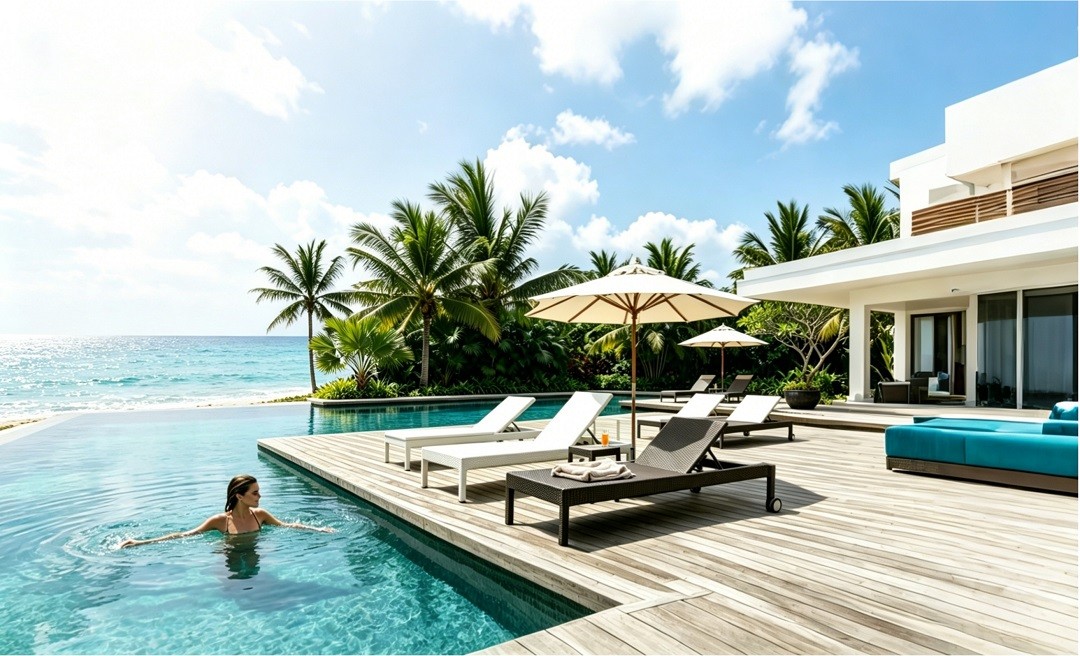
Synthetic Wicker Hotel Furniture: UV Stability And Embrittlement
Synthetic wicker is the classic resort language: textured, warm, immediately legible as relaxed luxury. Commercial HDPE resists chlorine, salt and mould without sealing or oiling. What matters is virgin HDPE with a UV stabiliser, not cheaper PVC blends that crack after a few seasons of direct sun.
Watch for embrittlement rather than fading — the point where a strand stops flexing and cracks at its tightest turn around the frame. Ask for accelerated UV data on the actual strand, confirm weave density and anchoring, and approve a swatch in daylight.
Where woven elements earn their place
Shaded terraces, cabanas and covered restaurant decks, where texture matters and UV load is moderated.
Where frames should lead
Exposed beachfronts, chlorinated pool edges and high-turnover decks cleaned daily.
Most outdoor hotel sofa programmes therefore combine the two: an aluminium structure carrying a woven skin, keeping the resort aesthetic without asking the weave to do structural work.
Powder-Coated Aluminium Hotel Furniture: Wall Thickness, Finish And Fixings
Aluminium is the coastal default: it does not rust, staff can reconfigure it, and it takes clean contemporary profiles. But the material name alone is not a specification. Wall thickness, the coating system and — critically — the fixings decide whether a frame survives salt air. An aluminium frame with 316 stainless hardware and the same frame with mild-steel screws are not the same product.
A contract brief should state the alloy, wall thickness around 1.5–2.0 mm, welded rather than pop-riveted joints, and a 60–80 micron powder coat to a recognised performance class. Coastal projects should ask for salt-spray evidence to ASTM B117 or ISO 9227, UV data to ISO 4892-3 and EN 581 structural testing; our certificates and test evidence are available during specification. Then ask about hardware: first rust in a marine environment almost always appears at a fastener, weld seam or base cap, not across the frame. Fixing grade, isolation and glides belong on the drawing.
Outdoor Hotel Furniture Material Comparison For Heat, Salt And Sun
| Site condition | Favoured specification | Check before approval | Fails first |
|---|---|---|---|
| Coastal, full exposure | Powder-coated aluminium, 316 fixings | Coating build, salt-spray data, hardware | Fasteners, seam edges |
| Inland, high heat | Most materials; shade does more work | UV stabiliser, surface temperature | Unstabilised polymers |
| Sheltered terrace | Rope weave or wicker over aluminium | Polymer grade, daily cleaning agents | Weave tension, crevices |
| Poolside, chlorinated | Rinse-tolerant frames, solution-dyed fabric | Chlorine residue, covers, drainage | Cushions, foam |
| Seasonal operation | Lightweight, stackable, breathable covers | Stack height, glide wear, storage airflow | Handling damage, mildew |
Use this zone by zone: two decks on the same island can sit in different exposure classes.
What Luxury Resort Buyers Should Ask An Outdoor Hotel Furniture Supplier
Experienced buyers reject suppliers on missing evidence, not price. We prepare as standard:
- Test evidence for the quoted assembly — UV, salt spray and load reports, not a generic sheet.
- Named materials — polymer, stabiliser, alloy, wall thickness, coating build, fixing grade, fabric, foam.
- Physical approvals — swatches in daylight and a first-article chair housekeeping can rinse, stack and move.
- Spare strategy — about five per cent of seating, cushions and weave in the original run; batches rarely match later.
- Drawings and packing — shop drawings fixing tolerances, joints and glides, plus carton specs for replacement.
- A realistic programme — approvals, production, inspection and phased delivery mapped to the opening date.
The sequence is on Work With Us; our Support team handles documentation and replacements, with related reading in the Karam Spaces Blog.
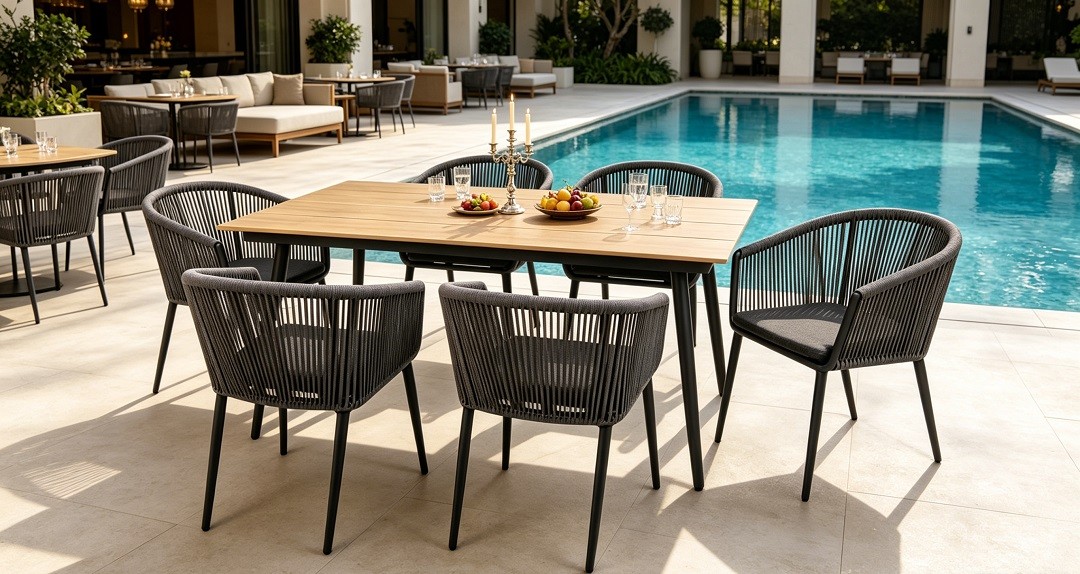
How A Hotel Furniture Manufacturer Specifies Coastal Projects
Karam Spaces designs indoor and outdoor seating systems for hospitality, working as both a Hotel Furniture Manufacturer and an Outdoor Hotel Furniture Supplier. Our coastal work includes Centara Resort Maldives, where weather-resistant loungers with quick-drying fabric and rust-proof aluminium frames were supplied for pool and beach zones alongside woven rattan dining chairs, and properties across the Gulf.
We begin with a site-condition brief — exposure, cleaning, storage, seat counts and opening sequence — then build a zone-by-zone schedule. Rope weave goes where shade and rinse-down exist; wicker is specified with a named polymer and UV data; aluminium frames carry a defined wall thickness, coating build and 316 fixings. Shop drawings, first articles and test evidence are approved before production, so a terrace added in year three still matches. See our case studies.
Frequently Asked Questions About Outdoor Hotel Furniture
Which material lasts longest at a beachfront resort?
In full coastal exposure, powder-coated aluminium with 316 fixings is the safest starting point. Woven elements still belong on shaded, rinsed decks; service life depends on cleaning and storage as much as on the material name.
Does aluminium outdoor furniture rust near the sea?
The frame does not; fixings, weld seams and base caps can. Hardware grade is the most commonly omitted line in a coastal specification, so ask for it explicitly.
Can rope weave furniture be pressure washed?
Generally no. A soft brush, mild detergent and low-pressure rinse suit most woven ropes; a lance opens the weave and accelerates fraying. Confirm the protocol before it enters a daily checklist.
What belongs in a five-star outdoor furniture specification?
Exposure class, cleaning method, storage plan, alloy and wall thickness, coating build and test evidence, fixing grade, polymer and UV data, fabric and foam, spares, shop drawings, packing and the approval programme.
Talk To An Outdoor Hotel Furniture Supplier About Your Site Conditions
Planning a new terrace, a pool deck refurbishment or a phased resort opening? Send us the location, the exposure of each zone, your cleaning routine, whether furniture is stored off-season, and the seat counts and target date. We will return a zone-by-zone material schedule, finish and weave options, the test evidence behind each recommendation and an indicative budget — so the design conversation starts from your actual conditions.
Send us your project brief → Speak with the Karam Spaces technical team →